
4 August Lilies for Middle Georgia
- Clifford Brock
- Aug 21, 2022
- 3 min read
Updated: Aug 21, 2022
I'm on a quest to collect all Lycoris! Well, perhaps not all, but at least the ones that grow well in my hot and humid Georgia garden. You may have heard them called Surprise Lilies or Spider Lilies, or even Naked Ladies- but I find that image disturbing so I don't like it. There are a whole suite of species and hybrids that bloom at different times starting in late July and lasting through September. This article only deals with the early blooming (August) selections.
Well, here we are in late August and with a recent dry/cool spell as well as plenty of soaking rains, we are in the transition from summer to fall. Plants, just like us, respond to cooling night-time temperatures by taking on a bit of exuberance and by brightening their colors. When that first rush of autumn air blows through we all feel a little more spunky, don't we?
Most gardeners are familiar with the iconic red spider lilies that bloom in September. They can be seen around old homes and scattered around the woods where houses once stood. Yet despite being rapid multipliers and commonly encountered, they are rarely offered in modern nurseries. They are the triploid form of Lycoris radiata, often labeled, var. radiata.
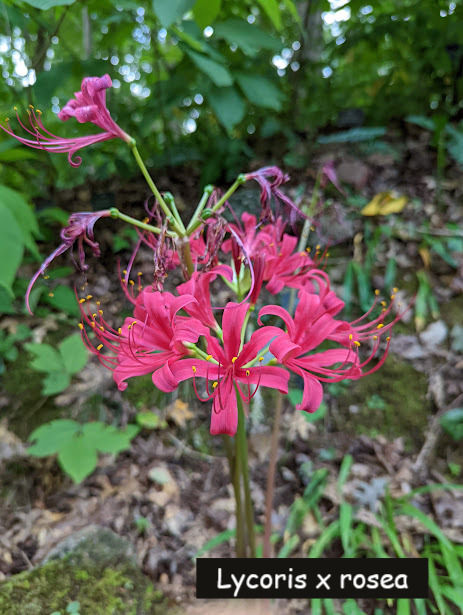
But my aim now is to draw attention to the lesser-known species and hybrids that bloom starting in late July and continue through the month of August, well before Lycoris radiata var. radiata. The first to bloom in my garden is Lycoris x rosea. Sometimes referred to as Lycoris x haywardii, this is a hybrid between the blue-pink Lycoris sprengeri and the dwarf red Lycoris radiata var. pumila. These hybrids come in a range of colors from blood red, to purple pink and they are typically a little shorter than the following selections.
Btw, I've found x rosea easier to grow than its parent L. sprengeri, and while they don't replicate as fast as the more common heirloom red spider lily, they do increase at a modest rate and produce fertile seed.
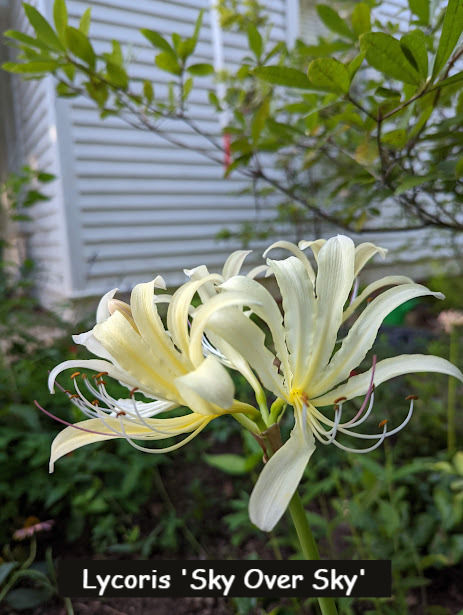
Lycoris x caldwellii hybrids are crosses of the white surprise lily (Lycoris longituba) with the golden Lycoris chinensis. The resulting plants are tall (up to 24 inches) and usually a creamy white-yellow color. 'Sky over Sky' offered by Plant Delights has been a reliable bloomer for me.
The third group I'd like to mention are the L. x straminea hybrids which are also sometimes called x houdyshelii. I know all of this is confusing, but I feel like it is important to list all the possible names you might encounter in trying to sift through this complex genus. These are either natural or man-made hybrids between Lycoris radiata x Lycoris chinensis. Many named selections are now offered, and they typically run from pure white to peachy pink and dull yellow. I'm really excited about the clone, 'Caldwells Original' because it seems to multiply reasonably fast and it is a wonderfully elegant ivory hue. A nice clump of this grows in Athens at the Day Chapel at the State Botanical Garden in a patch of southern shield fern.

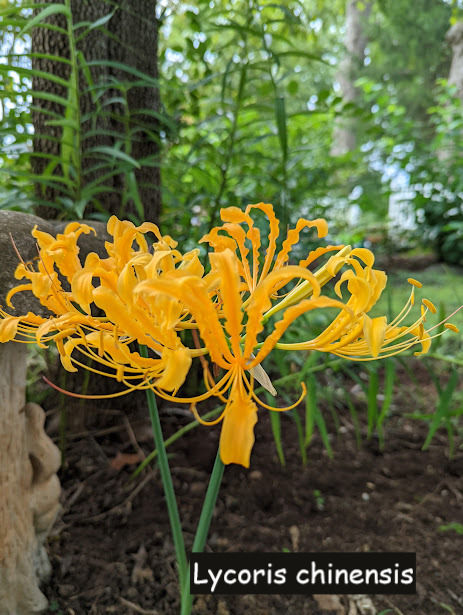
Lastly I'd like to bring attention to the golden surprise lily, or Lycoris chinensis, aka, Yellow August Lily. This is the earlier of the 2 main yellow species, with the latter being Lycoris aurea which blooms toward the middle of September. Lycoris chinensis differs because its leaves emerge in late winter and are slightly bluish. While the later L. aurea has duller, greener leaves and more of a "spidery" look to the petals.
This Lycoris is also far hardier than the Saint Augustine Lily (or Lycoris aurea) because its foliage emerges in late winter as opposed to the fall emerging aurea.
This is a magnificent stately lily that deserves to be in so many more gardens! Its bright yellow color lightens up every place it's planted. One pitfall of this species is that it is relatively slow to multiply. But it is truly a sight to behold when in full glory.
As with all members of the Amaryllis family, Lycoris are relatively pest free, yet they are plagued by black lubber grasshoppers and armadillos. Armadillos are particularly devastating this year and I've had to replant many bulbs they've excavated. Luckily, the armadillos don't eat the bulbs, they just unearth them which can leave them vulnerable to sun damage and desiccation. I really dislike armadillos!
You can find these gems at Bulbmeister, Eden's Blooms, Terra Ceia, Plant Delights, and Southern Bulb Company.


Comments