
Musky Sasanquas
- Clifford Brock
- Oct 23, 2022
- 3 min read
Of all the floral scents, nothing transports me back to childhood quite like the smell of sasanquas. It is always impossible to accurately describe an olfactory experience, yet I'd liken it to a sultry musky fragrance. And of course I can't separate it from the burnt sugary dried leafy smell of fall. In my mind the two are inseparable. Just as every season has its flowers, so too does every season have its "smells".
When I was a child, I spent a lot of time with my paternal grandparents. And every year, around Halloween their large Camellia sasanqua would bloom and its fragrance would permeate the entire yard. To this day that smell will trigger deep memories of my grandmother and her house. I also remember on particularly warm days the flowers would be buzzing with countless yellowjackets yet they never seemed aggressive.
It's interesting how few people realize that sasanquas are also Camellias. Most folks know the iconic Camellia japonica or the old-timey "camellia" that we so often see in the deep south. Yet the genus Camellia, containers tremendous diversity, from tiny flowered, boxwood-like bushes to giant tree-form shrubs with colorful bark. There is a camellia for everyone, and all of us need at least one!
Camellia sasanqua is often a pass-a-long shrub rooted and shared by grandmothers for eons. It differs from japonica, by having 1) smaller flowers and leaves 2) a more vigorous bushy growth habit, and 3) exhibiting a musky fragrance. Generally speaking, it typically blooms from September to December whereas japonica blooms later in the winter and early spring yet there are many exceptions.
Unlike other camellias it produces tons of seeds that freely germinate underneath the mother plant. I suspect many of the pale pink forms so common across the south were originally seedlings and not cloned or rooted selections. My largest sasanqua, that I've limbed up as a tree, was a seedling I dug up long ago at the State Botanical Garden. It has a nice saturated pink tone that is quite rare among seedlings.

Today, there are numerous cultivars and many colors to choose from. However, there still is a bias towards the larger flowered japonica and hybrids as the mass public still doesn't quite know the distinction.
While I have around 5 different clones in my garden, and I often forget the names or get mixed up, here are a few that I can suggest.
'Leslie Ann' is a glamorous glossy leaf selection that peaks around mid. November and has white or pink flowers rimmed with almost a purple edge. It is a dense shrub that grows equally well in full sun or deciduous shade. Of all my fall-blooming camellias, this is probably my favorite.

Another somewhat popular cultivar is 'Mine-No-Yuki' or 'White Dove' is a white double with a wispy weeping form that often needs staking to remain upright. My specimen, while it has beautiful blooms, is not the most attractive garden specimen. Though I guess I shouldn't be so harsh because it has been hit by numerous pecan branches and hasn't quite recovered a "desirable" shape. I suspect I'll have to rejuvenate it by cutting it back to the ground and allowing a new leader to form. I recently brought some blooms inside and put them in a vase, but I was disappointed at how quickly it dried and shed... so perhaps it's not the best cut-flower. However, my pink forms seem to last much longer!

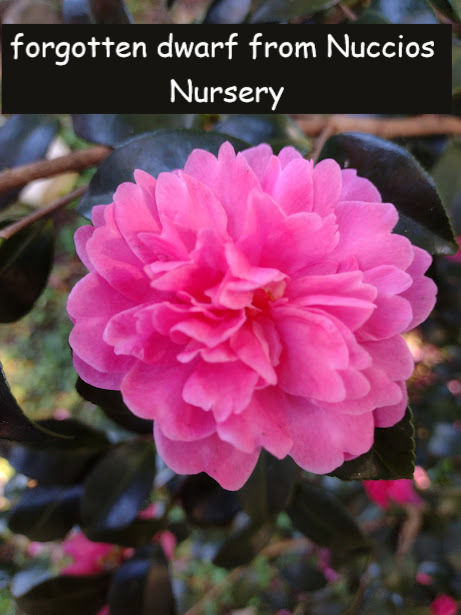
Sorry, I can't come up with more cultivars to showcase. Sadly, I've lost so many of my tags over the years. I would like to mention a dwarf cultivar with tiny flowers and an overall weeping habit. It produces mum-like pink flowers in November, and I originally ordered it from Nuccio's Nursery in southern California. Perhaps one day I can re-discover the name.
I urge you to experiment and plant at least one fall-blooming sasanqua in your yard not only for the colorful flower but also for the unique memory-making scent. These are quick-growing, tough-as-nails, shrubs that will give generations of enjoyment!
Many of these gems can be found at County Line Nursery in Ga, Camellia Forest Nursery in Nc, Woodlanders in SC, and Nuccios in California.


Comments